
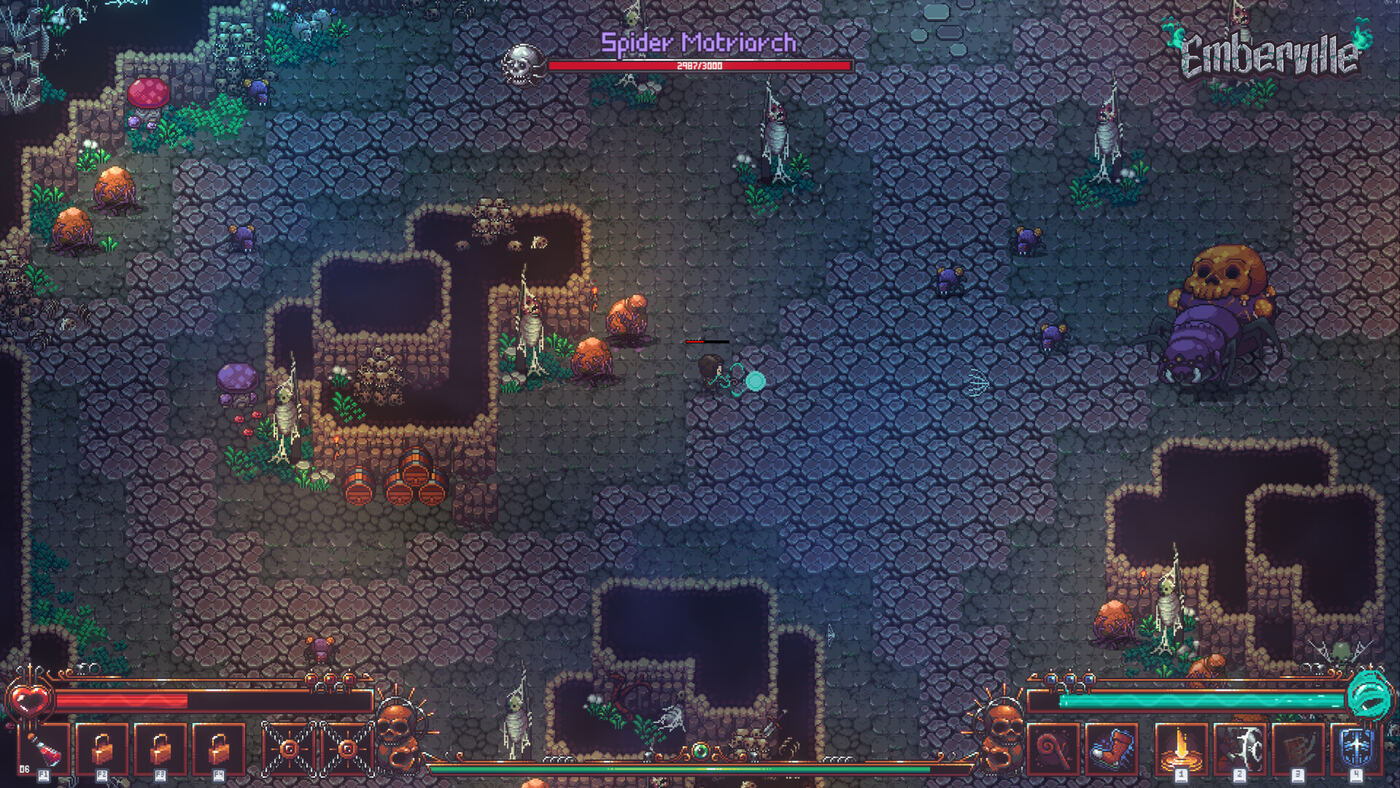
Emberville combat is an action problem before it is a numbers problem. Where you stand and when you commit decide most fights, and the character sheet only sets how much room for error you get. The dungeon states the stakes openly: enemy levels float above their heads, a 36 over one creature and a 13 over another, so a room tells you whether it is a fight or a detour before anything swings.
The store page describes the combat as action-driven and "focused on positioning and timing". That sentence is the whole design in miniature. Everything below follows from it: the combo system, the four defensive stats on the panel, the boss bar at the top of the screen, and the two Steam tags that sit under the game's genre line.
Positioning and timing come first
Attacks commit you to a direction. Enemies telegraph. The space between your character and the nearest hitbox is the resource you spend, and it refills slower than health does.
That makes three habits worth more than any single stat:
- Read the level number before the room. An enemy several levels above you is not a damage check you can brute force; it is a signal to fight in a doorway or not at all.
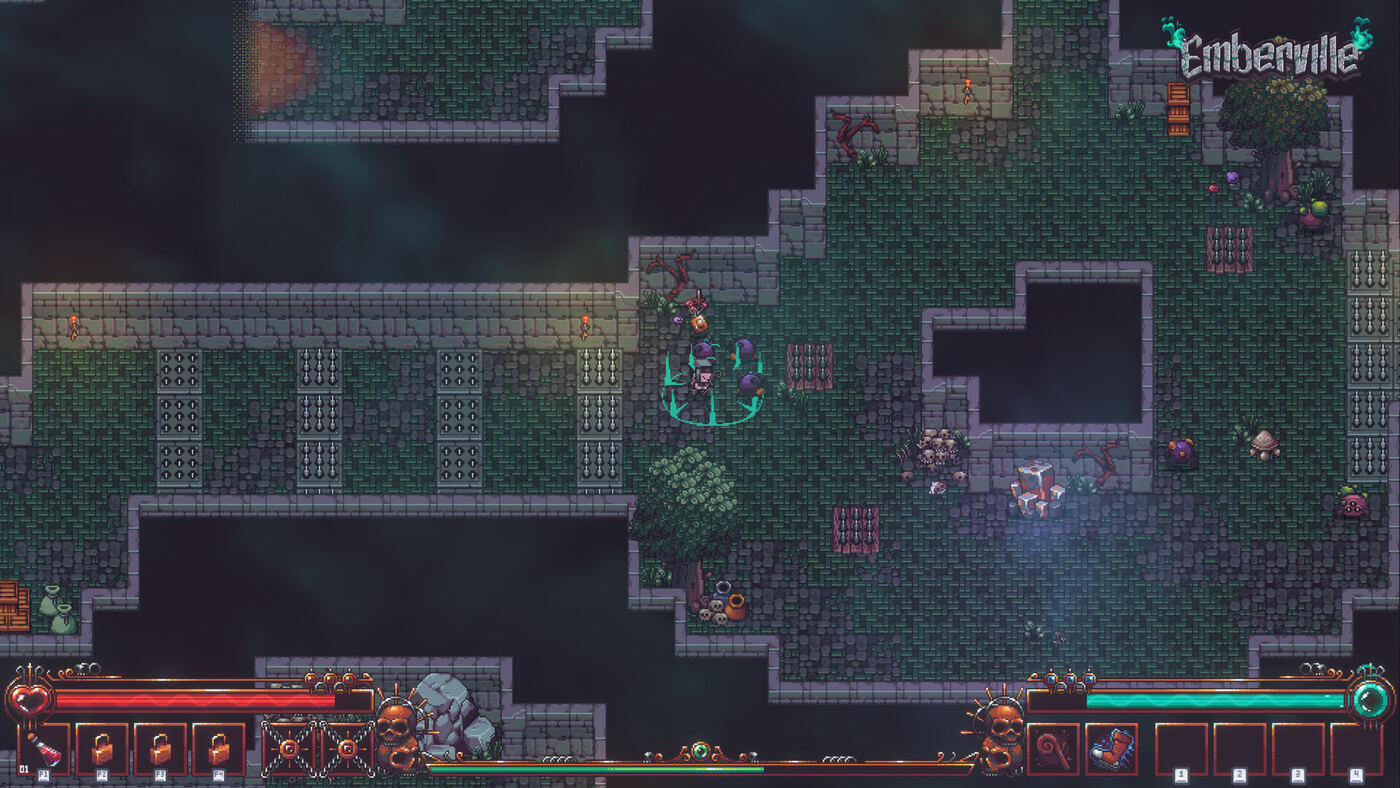
- Keep one exit behind you. Corridors and pillars break line of sight on ranged attacks, and a green flagstone hall with a barrier in the middle gives you something to circle.
- Accept the whiff. A swing that misses costs a beat. A swing that lands into a counter costs a health bar. The game is built so the second mistake is the expensive one.
Combos belong to the weapon, not the class
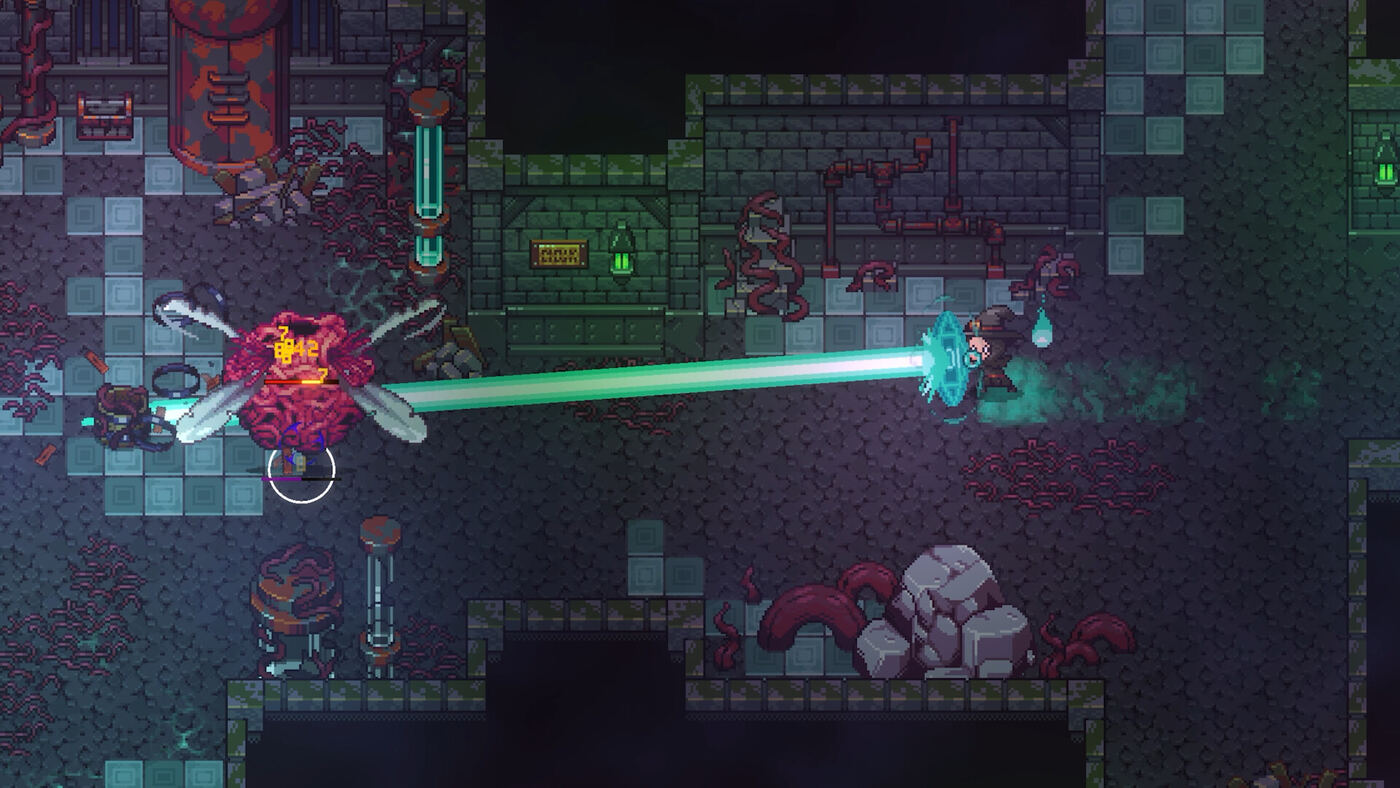
Emberville binds its combo trees to weapons. Each weapon carries an independent tree, and a sequence chains different attack types together instead of repeating one animation on a loop. Swapping what you hold therefore swaps the fight, without a respec and without leaving the dungeon.
This is the mechanical reason classes can be changed at any time and can inherit skills from one another. Because the combo tree lives on the weapon, a class is a set of tools you bring to a weapon rather than the thing that defines your damage. The build that emerges is a weapon plus the passive and active skills you carried into it.
Practically, a weapon with a wide arc wants you in the middle of a pack and a weapon with a narrow arc wants a corridor. Learning one tree well beats spreading practice across four, because the trees do not share muscle memory.
Defence is something you do
The character panel lists Block Chance, Block Amount, Parry Chance, Counter Attack Chance and Move Speed alongside the offensive numbers, and the names are precise about how defence works. Block Chance and Block Amount describe a guard that absorbs a quantity of damage. Parry Chance and Counter Attack Chance describe a window: you press at the right moment, the hit does not land, and the opening that follows is yours.
None of that resolves in a menu. A parry is an input with a timing requirement, not a passive roll that happens because a percentage was high enough. Move Speed sits in the same list for the same reason — it is a combat stat, the one that decides whether you can leave a swing's reach before it connects.
The practical consequence is that a defensive build is not a build that takes less damage by default. It is a build that makes the correct input pay more when you land it.
Bosses get their own bar
Ordinary enemies wear a level number and nothing else. Bosses are different: the Spider Matriarch fills a room and carries a dedicated health bar across the top of the screen, which separates the encounter from everything else standing in it.
That bar does two things for the player. It makes the boss the only progress readout in the room, so adds and summoned clutter never blur how much of the fight is left. And it signals that the fight is an authored set piece with a shape, not an oversized version of the creature you met in the corridor — which is why the arena matters as much as the attack pattern.
What the difficulty setting changes
Two Steam tags describe the rest of the frame: Adjustable Difficulty and Save Anytime. Neither is a footnote.
Adjustable difficulty matters more in a timing game than in a stat game, because players arrive with very different reflexes rather than different gear. The setting lets the same encounter be a puzzle or a brawl. Saving at any point matters for the same reason: a bad room is a lesson you can walk away from instead of a checkpoint you have to grind back to.
Dying is not the end of the run
Death in the Vitromotus feeds the premise. Kymia, the energy that saturates the prison, returns the dead to it, which is why the corridors are populated by things that have had a very long time to change. A wipe costs progress and position, not the character.
That changes how to approach a hard room. The cost of trying is time, so the correct move against a wall is usually to test it — pull one enemy, learn the tell, and see what the room does when it is half empty — rather than to leave and grind levels elsewhere.
Reading a fight in four seconds
The sequence that covers most encounters:
- Count the nameplates and note the highest level among them.
- Find the surface you want your back to — a wall, a doorway, a barrier — and move so the pack has to come at you one at a time.
- Open with the attack type your weapon chains from, not the one with the biggest number.
- Hold the defensive input for the tell you have already seen once. The first hit of an unfamiliar enemy is information, not damage.
Everything else — skills inherited across classes, gear pulled out of the same rooms, the town that sends you back in — is downstream of those four steps. The town is where the run gets easier; the corridor is where it gets decided.
Next step
- Emberville Classes Swap at Will and Share SkillsEmberville classes can be changed at any time, and passive and active skills carry across them, so a build is a skill set rather than a locked role.
- Emberville Town Rebuilding: Rescue, Trades, Living HubEmberville town rebuilding runs on one loop: free a survivor, learn their trade, and the ruined settlement becomes a hub of shops, quests and unlocked systems.
- Town rebuildingRescued survivors bring trades, quests and shops, and the hub grows around them.