
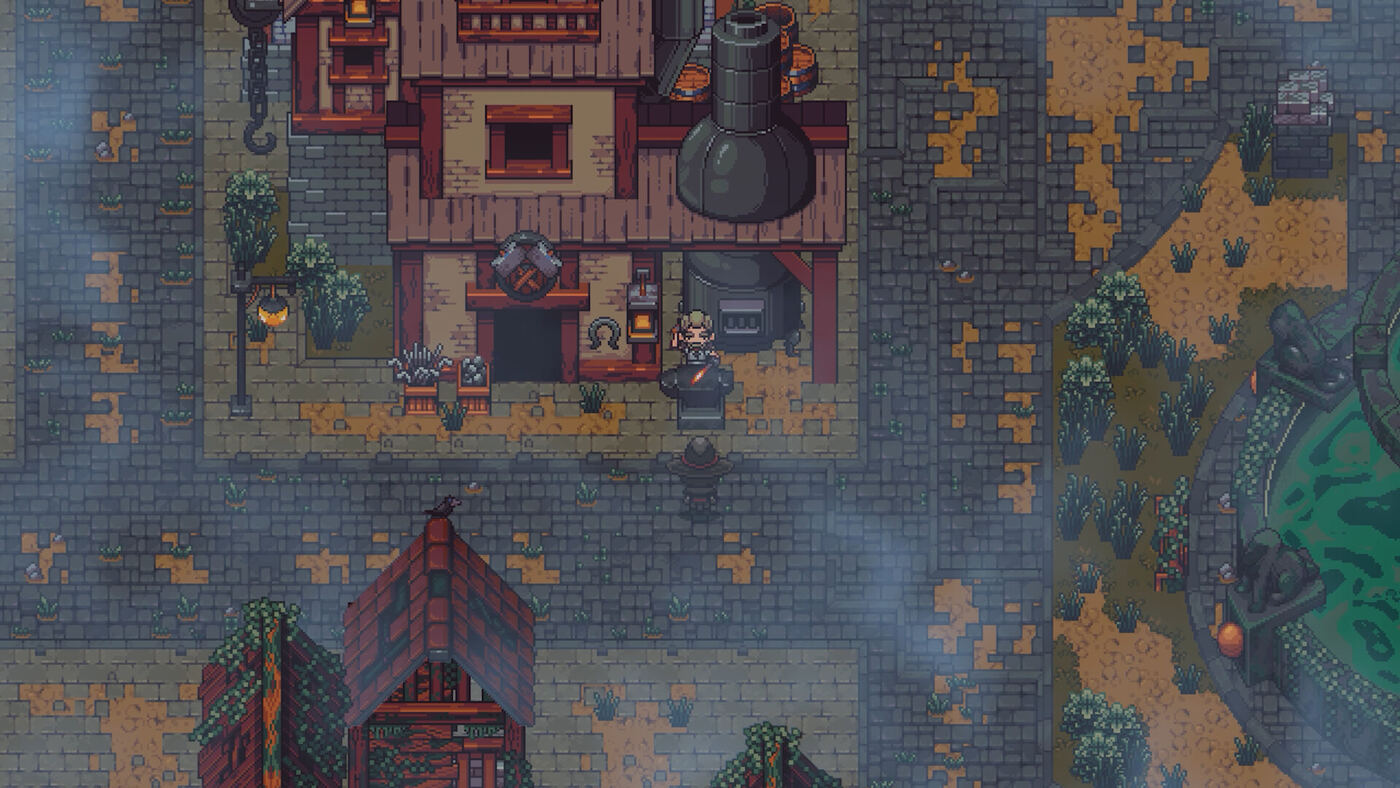
Emberville crafting is a full profession layer, not a side bench. Gathering and crafting exist as classes of their own, and the output covers five categories: equipment, potions, food, tools and trinkets. The estate is the other end of the same system — a place you build for yourself, with structures, furniture, plants and decoration, and the storage and rest that make a long descent survivable.
Both halves draw on the same supply. Materials come out of the Vitromotus, which means the crafting loop and the combat loop are the same loop entered from different ends.
Gathering and crafting are jobs
The store page lists gathering and crafting among the game's professions, and treats them as real occupations rather than a menu of recipes attached to every character. That matters for how a run is paced.
A player who leans into gathering reads the dungeon differently. Rooms with vegetation, mineral seams and creature remains stop being obstacles and start being inventories. The same corridors that a combat build sprints through become a route with stops on it.
Crafting then converts that haul. Because classes in Emberville can be swapped at any time and inherit skills from one another, a crafting profession is not a commitment you make at character creation — it is a mode you can move into when the stockpile justifies it, and move out of when it does not.
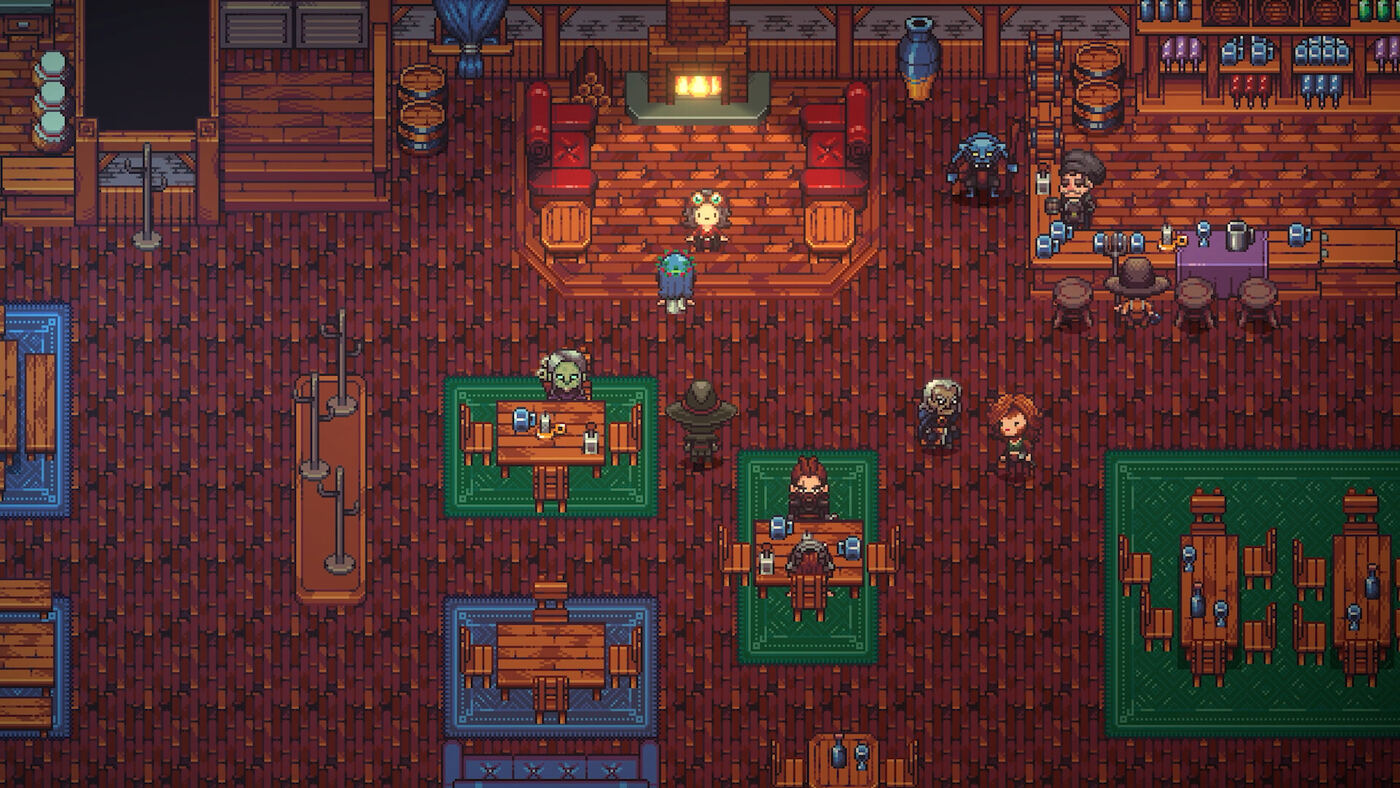
The five things a bench produces
Each output category solves a different problem, and none of them is filler:
| Output | What it is |
|---|---|
| Equipment | Weapons and armour, worn into the next room |
| Potions | Bottled consumables carried on a run |
| Food | Provisions, made rather than bought |
| Tools | Implements for the work rather than the fight |
| Trinkets | Small worn items that sit in their own slot |
Equipment is the category that overlaps most with combat, because a crafted weapon also carries its own combo tree. Potions and food are the categories you spend rather than keep — a consumable you can replace is a mistake you can afford. Tools and trinkets are where the estate and the character sheet meet: one belongs to the workshop, the other to the body.
Materials come from the dungeon
Nothing on that table is bought outright. Materials are pulled from the Vitromotus — the same rooms that hold the enemies and the survivors — and that single decision keeps the whole economy pointed downward.
It also means the crafting layer scales with depth. The first biome supplies what the first biome's recipes need, and the plan to reach nine biomes before 1.0 is a plan for the material pool as much as for the story: new equipment and new building materials arrive with the new regions, alongside new enemies and quests.
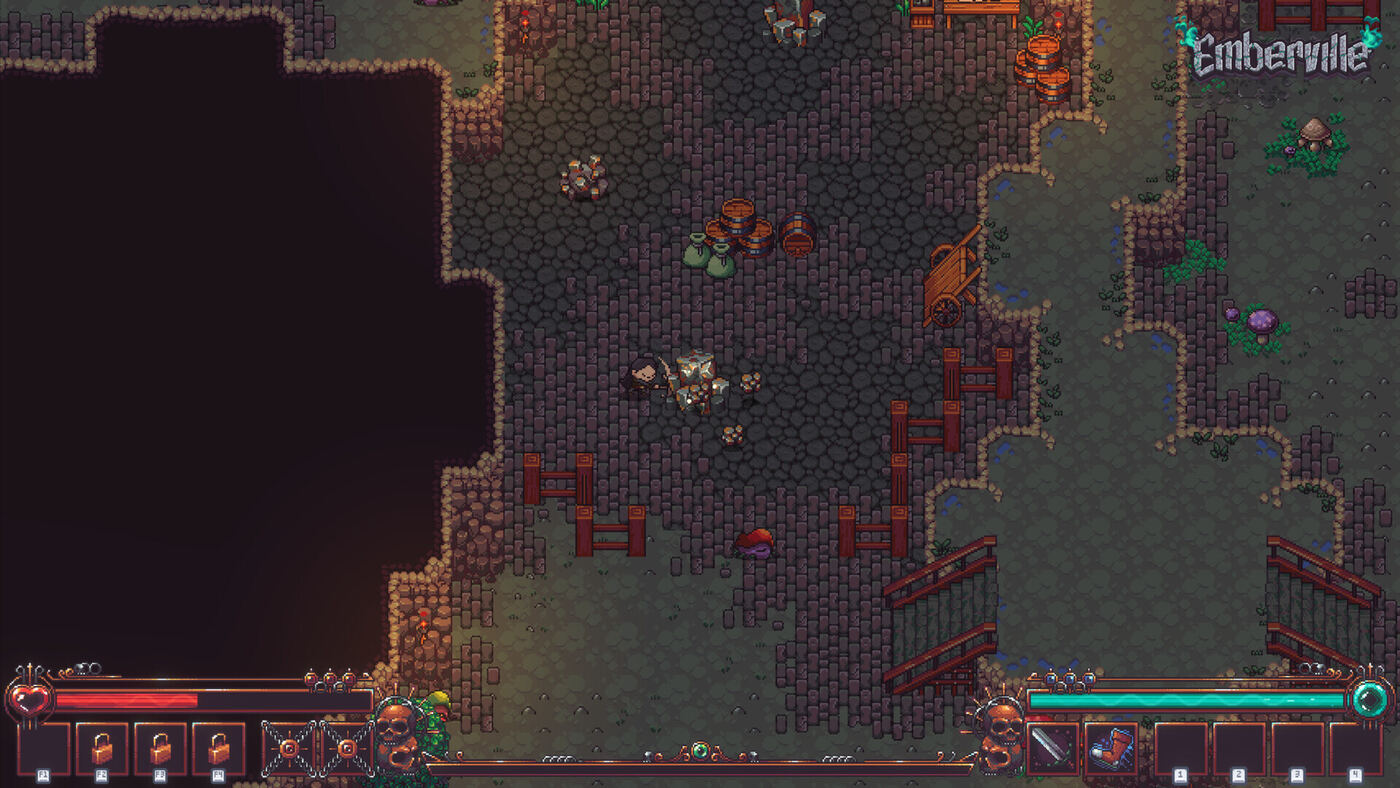
The estate is a build, not a menu
The estate is the part of Emberville that belongs entirely to the player. It supports buildings, furniture, plants and decoration, which is a wider brief than a storage chest and a bed.
Read that list as four different kinds of decision:
- Buildings set what the estate can do — the structures that hold work, storage and rest.
- Furniture dresses the interior, and the game treats that as worth doing rather than as filler.
- Plants put something growing on ground you own, which is the one place in the game where the player controls the greenery.
- Decoration is the layer with no mechanical argument at all, and its presence is the clearest statement that the estate is meant to be looked at.
The freedom is the point. A player who wants a working compound and a player who wants a house with a garden are both using the same system.
What the estate is for
Two functions sit under the decoration. The estate is where the character rests between descents, and where materials and finished goods are stored. In a game where death returns you to the prison rather than ending the run, a stable base is what turns a long session into a series of attempts instead of one continuous grind.
That is also why the estate pairs so directly with town rebuilding. The town is the public hub — shops, quests, residents, the day clock. The estate is the private one: no quests, no queue of villagers, just the buildings you raised and the stock you have accumulated.
Order matters less than it looks. Raising storage first means the stockpile has a home before the haul arrives; decorating first means the place looks like somewhere you chose to live. Neither order is a mistake, and the estate grows across a run rather than in a single planning pass — a wall added late is as valid as one raised on the first visit.
How the two halves feed the loop
The crafting system exists to shorten the distance between a failed attempt and a good one. A potion replaces a lost fight. A crafted weapon replaces a bad matchup. A tool shortens the gathering trip that pays for both. An estate shortens the walk.
None of that requires the player to stop fighting. The professions are adjacent to combat rather than a replacement for it, which is why the game can put a crafting class next to a combat class and let the same character be both across a single evening.
The loop closes upward: materials out of the Vitromotus, goods out of the bench, buildings on the estate, and a better-equipped character back down the stairs. The classes page covers the other half of that — what the character can do when the gear is already good.
Next step
- Emberville Town Rebuilding: Rescue, Trades, Living HubEmberville town rebuilding runs on one loop: free a survivor, learn their trade, and the ruined settlement becomes a hub of shops, quests and unlocked systems.
- Emberville Classes Swap at Will and Share SkillsEmberville classes can be changed at any time, and passive and active skills carry across them, so a build is a skill set rather than a locked role.
- The VitromotusThe prison the materials come from, and the energy that keeps it populated.